

DESIGNING PAPER-PIECED PATTERNS

From time to time someone asks me how to get started in designing paper pieced patterns. The following is a verbal description of the gist of the process for me. It is 95% on the computer, using Illustrator, Photoshop, and InDesign, but my way is just one way--not THE way.
If you haven't already, study several paper-pieced patterns to get a fairly good idea how they're constructed. All straight lines...right? If you have patterns from several designers, compare them. Look at the details--where the seam lines are, where numbering starts, etc. No two people will approach it the same way.
Idea
At the idea stage, I might sit in front of the tube in the evening with scratch paper and a pencil, and I sketch/doodle whatever comes into my head. If I have a subject, I try to think of lots of different ways to present it. Nothing formal...draw in as relaxed a state as possible. Doesn't matter the size at this point, because I am going to scan it into the computer.
If you can't draw, practice by using simple clip art (for your personal use only).
Scan
When I get a little picture I like (or parts of several pictures), I scan the drawings and save them as .jpgs. Next I open a new file in Illustrator, and place the .jpgs on the page. (If you're doing this by hand, you can enlarge your pictures on a copy machine. You'll also need lots of tracing paper for the rest of the steps.)
Trace
I enlarge the .jpg to a working size in Illustrator and dim it to about 50%, so I can see the lines I will be adding. On another layer, I draw a square around it to represent the block size. I trace over my .jpg, using straight lines only, following the outline of the object and its most prominent details. I may have to sacrifice some details to piecing later, but the idea is to choose the details that are key to identifying the object.
At this point I may add color to my pattern so I can see where the major color areas are. I put the color on a different layer so I can "turn off" all the distracting black lines and see how things look without them.
Break Up Drawing into Major Sections
Look over your pattern and find the most natural seam line that will cut the block into two. This is the last seam actually sewn, and every block has one. It could be vertical or horizontal. I make that line heavier. Now work to break up each side into sections using more heavy lines. I like my section lines to follow the large shapes in the drawing, but some designers prefer to make squares (Ex: Foundation Piecer) and break those into smaller pieces. I always aim at having the fewest sections possible, because those are the most labor intensive seams to sew (requiring pinning, matching, etc.).
Break Up Sections into Pieces
Look at the sections of patterns and see how the piecing lines often radiate out from some detail, or an inside curve. I will add piecing lines and move them around until I get the the smallest number of pieces, and I often need to move, change, add, or delete the section lines as I go. Other times I need to sacrifice detail in order to make the piecing less fussy.
While you are breaking up each section, you have to make sure there is a workable order of piecing. When numbering pieces you must be able to lay down your fabrics one after another. Previous pieces cannot overlap later pieces.
Numbers and Color Abbreviations
When I get workable sections, I add the type (the numbered order of piecing). Because there is color in my pattern at this stage, I label the colors in each piece (seeing the color helps me make fewer mistakes). I print my test patterns in color, but I remove the color in the final stage and add a gray grid to the background area.
Test Sew
I may discover some undesirable things when I sew the pattern, and that's when I go back to fix things in Illustrator. After that there is resewing, photographing, pattern writing and website work.
The bit of the pattern process:
In 2014, the Two Raccoons pattern morphed like so:
Design doodle:
Tiny clues to paper-pieced design
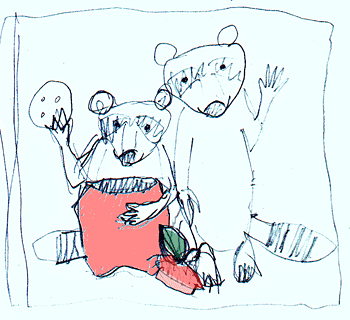
I wasn't fond ofthe straight tails or the eyes, so I changed them. And it felt like they were floating in space, so I gave them a rug to sit on.
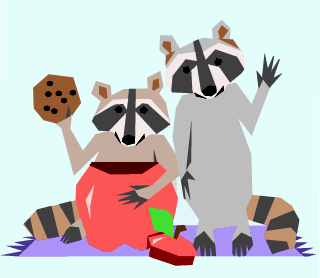

I looked at pictures online of real raccoons to get the markings and coloring.
(Ever wonder how many paper-piecing designers there are in the whole wide world?)